CURATORIAL STATEMENT
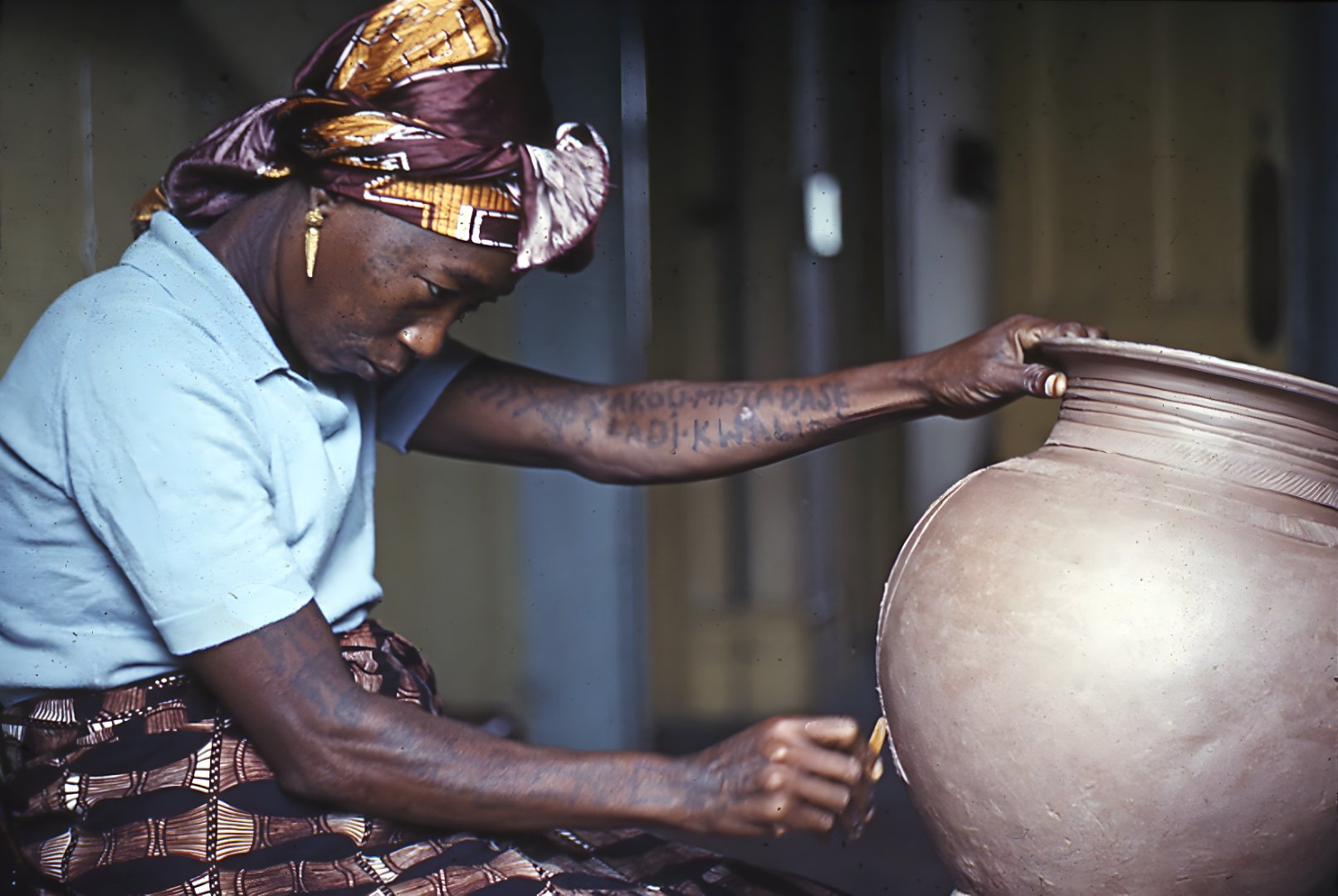
Ladi Kwali: Beyond the Vessel brings together a range of ceramics and archival materials relating to Ladi Dosei Kwali (1925–1984), drawn from the collection of the National Museum, Onikan, Lagos, and from private lenders. Born in the village of Kwali in northern Nigeria, she learnt pottery from her aunt, mastering the hand-building and coiling techniques central to Gbari matrilineal traditions. She became Nigeria’s most internationally recognised potter of the period, bringing the knowledge of Gbari pottery traditions to a new network of production, exhibition and circulation.
The title takes the vessel as its starting point: a form central to pottery traditions, yet continually taken apart and remade by a new generation of artists working with clay. To move beyond the vessel is also to move beyond the terms in which Kwali herself has been received: beyond craft as a category positioned below art; beyond her placement in museums abroad, often in the shadow of the British studio potter with whom she worked; beyond the twenty-naira note, where she is widely recognised but less often examined; and beyond her own lifetime, towards the artists and practices her work made possible.
The exhibition returns attention to the objects and networks of Gbari women's pottery traditions from which they emerged. Alongside ceramics by Kwali are works by two women potters from the community who worked alongside and after Kwali, including Kande Ushafa and Asibi Ido, and traditional pottery made by Gbari, Nupe and Bida potters. Read together, they trace a specific technical passage: from hand-built water pots made without the potter’s wheel to throwing a teapot, tankards, bowls and casserole dishes, and the shift in what a woman potter would usually be permitted to make, sell and sign.
Archival material situates this within the Pottery Training Centre founded at Suleja, then Abuja, founded by British studio potter Michael Cardew (1901–1983) in 1951. Kwali's admission opened the centre to other women from her community, including Ushafa and Ido. There, an inherited tradition met new systems of production and local and international circulation, yet Kwali and her contemporaries carried on making hand-built forms and incised decoration intact through all of it.
What the exhibition asks of visitors extends beyond ceramics. Kwali's career raises the question of what conditions allow a woman to build and sustain a life in art at all: access to training, the cost of materials, institutional support, and recognition that outlasts a single celebrated figure. Clay answers part of that question. It can be dug from the ground, and across the twentieth century women denied bronze, marble and patronage turned to it precisely for that reason, in Nigeria and well beyond it. Kwali stands at the head of that lineage rather than alone at its summit.
In the year ART X Lagos marks a new chapter and a new decade, Ladi Kwali, Beyond the Vessel holds these histories together: what is inherited, what is transformed, and what is carried forward.
Ladi Kwali: Beyond the Vessel is conceived and developed by Dr Jareh Das for ART X Lagos 2026 and is part of her ongoing research into Ladi Kwali and the wider histories of Black women artists working with clay.
This exhibition was curated by Dr. Jareh Das and sponsored by Zenith Bank.
CURATOR BIOGRAPHY
Dr. Jareh Das is an independent curator working between the UK and West Africa. Her work explores the intersections of modern and contemporary art, as well as performance. Das holds a PhD in Curating Art and Science: New Methods and Sites of Production from Royal Holloway, University of London, where her research explored live art practices within the context of visual arts. Her curatorial and writing practices privilege embodied knowledge and move fluidly across exhibitions, performance, and critical texts. For over a decade, she has developed and led curatorial research projects with institutions across West Africa, Europe, Asia and the United states including Ford Foundation Gallery, Pond Society Shanghai, Camden Art Centre, Deptford X Festival, Frieze London and Galerie Atiss Dakar. Her writing spans exhibition catalogues, academic journals, magazines, and artist monographs, engaging closely with the practices of living and overlooked artists, as well as experimental forms of criticism. Das is currently working on her first book on Black women ceramicists and artists who work with clay.
Image credit: Portrait of Ladi Kwali decorating a pot_ William Alfred Ismay (W. A. Ismay). Photograph of Ladi Kwali at a pottery demonstration in England. 1970s. York Museums Trust. The W. A. Ismay B (2). Ismay, © York Museums Trust